
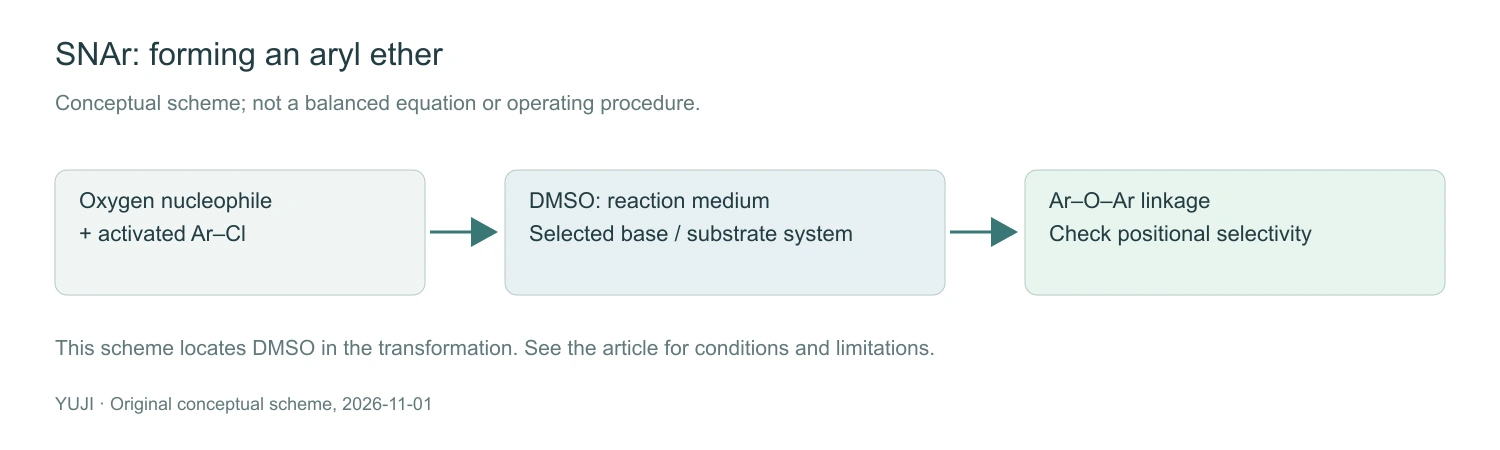
DMSO is used as the reaction medium in selected nucleophilic aromatic substitution reactions, or SNAr reactions. One practical use is forming an aryl ether when an oxygen nucleophile replaces a leaving group on an appropriately activated aromatic ring. DMSO provides the medium; the substrate, nucleophile and base determine the bond-forming step.
An aryl ether in an acifluorfen route
EP0706993A1 describes an initial coupling of 3-hydroxybenzoic acid with 3,4-dichlorobenzotrifluoride in potassium hydroxide and DMSO. The main product is 3-[2-chloro-4-(trifluoromethyl)phenoxy]benzoic acid, accompanied by a positional isomer. This is an intermediate-forming step before subsequent chemistry produces acifluorfen.
In simplified terms: an aryl oxygen nucleophile + an activated aryl chloride → an aryl–O–aryl linkage. In this example, the trifluoromethyl substituent helps distinguish the two positions available for substitution. The reported isomer formation is a reason to follow product identity and selectivity, rather than treating disappearance of the starting material as the only endpoint.
What the solvent can change
A polar aprotic medium can change the solvation and reactivity of ionic species. That helps explain why DMSO is considered for some substitutions, but it does not make every aryl chloride reactive. The location of activating groups, the leaving group and the nucleophile still matter.
Water belongs in the complete reaction balance. It may enter with the base, raw materials or reused solvent. Changing that balance can change the effective base system, phase behavior and reaction profile. Establish a water range for the selected route instead of assuming that the driest available DMSO must give the best result.
A clear liquid phase does not establish that every inorganic component is dissolved. Where solids remain, compare agitation and salt dispersion when moving between equipment or scales.
Judge the route through isolation
For a solvent trial, record conversion, the desired positional isomer and relevant side products against time. Keep substrate concentration, base composition and sampling conditions comparable. If several variables change, the result describes the new reaction system rather than the solvent alone.
Then check where the product and DMSO go during isolation. An acceptable reaction sample may still lead to product loss, difficult washing or retained solvent. Use isolated quality and recovery alongside the reaction profile to establish the process requirement.
For a DMSO sourcing review, share the specification established for your aromatic substitution and the intended isolation route with YUJI.