
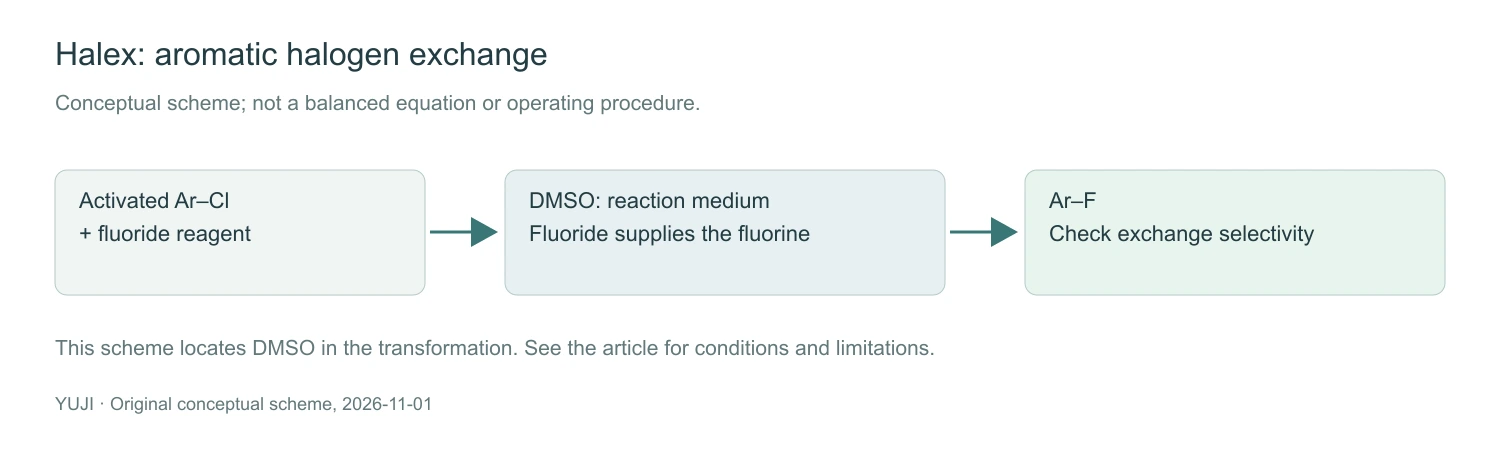
DMSO can serve as the liquid medium for selected Halex reactions: replacement of an aromatic chlorine or bromine substituent by fluorine. The fluoride comes from a reagent such as potassium fluoride. DMSO is the solvent, not the fluorine source.
Start with an activated aromatic substrate
Finger and Kruse reported aromatic chlorine-to-fluorine exchange using potassium fluoride in nonaqueous media including DMSO. Their work extended this chemistry beyond highly activated dinitrochlorobenzene systems. It provides a historical example of the solvent’s use, rather than evidence that every aryl chloride can be fluorinated in DMSO.
A useful reaction map is activated Ar–Cl + fluoride → Ar–F. Ring substitution and heteroaromatic structure determine whether the chosen carbon is sufficiently susceptible to attack. For a substrate with several leaving groups, the target may be selective exchange at one site rather than complete replacement.
Fluoride condition and mixing are part of the system
EP0944564A1 discusses halogen exchange with finely divided, essentially anhydrous alkali-metal fluoride and catalyst systems. It lists DMSO among several possible polar aprotic media. That distinction matters: a solvent appearing in an options list does not establish that it was the best-performing solvent in an experimental example.
For development work, record the fluoride source, particle condition, catalyst and water introduced with each material. If the fluoride is only partly dissolved, contact between the liquid and solids becomes an operating variable. Similar bulk temperature readings do not guarantee similar mixing or reaction behavior in two reactors.
Water control should therefore address the fluoride and other feeds as well as DMSO. An incoming-solvent COA alone does not establish the water content of the charged mixture.
Compare product quality at the end of the route
Follow the desired fluorinated product, unreacted substrate and partially or excessively exchanged products where relevant. Report selectivity and isolated recovery together. A shorter reaction time is not necessarily an improvement if impurity removal becomes more difficult.
Assess the complete heated mixture and its residues before scale-up. DMSO’s normal boiling point is a physical property, not an approved operating temperature for a fluoride/catalyst/reaction-product mixture. Recovery conditions and the acceptability of reused solvent also need to match the route.
For a Halex application, YUJI can review DMSO sourcing against the water limit and impurity controls established for your selected process.