DMSO can provide a reaction medium, but after the reaction it must be separated from the product. The useful starting question is where the product can go: into another liquid phase, into a washable solid, or into a solution for the next step.
DMSO is water-miscible and has a normal boiling point of about 189°C. Aqueous separation may therefore be worth evaluating before relying on evaporation. The actual choice depends on the quenched mixture and product stability.
In this article
Start with this decision sequence
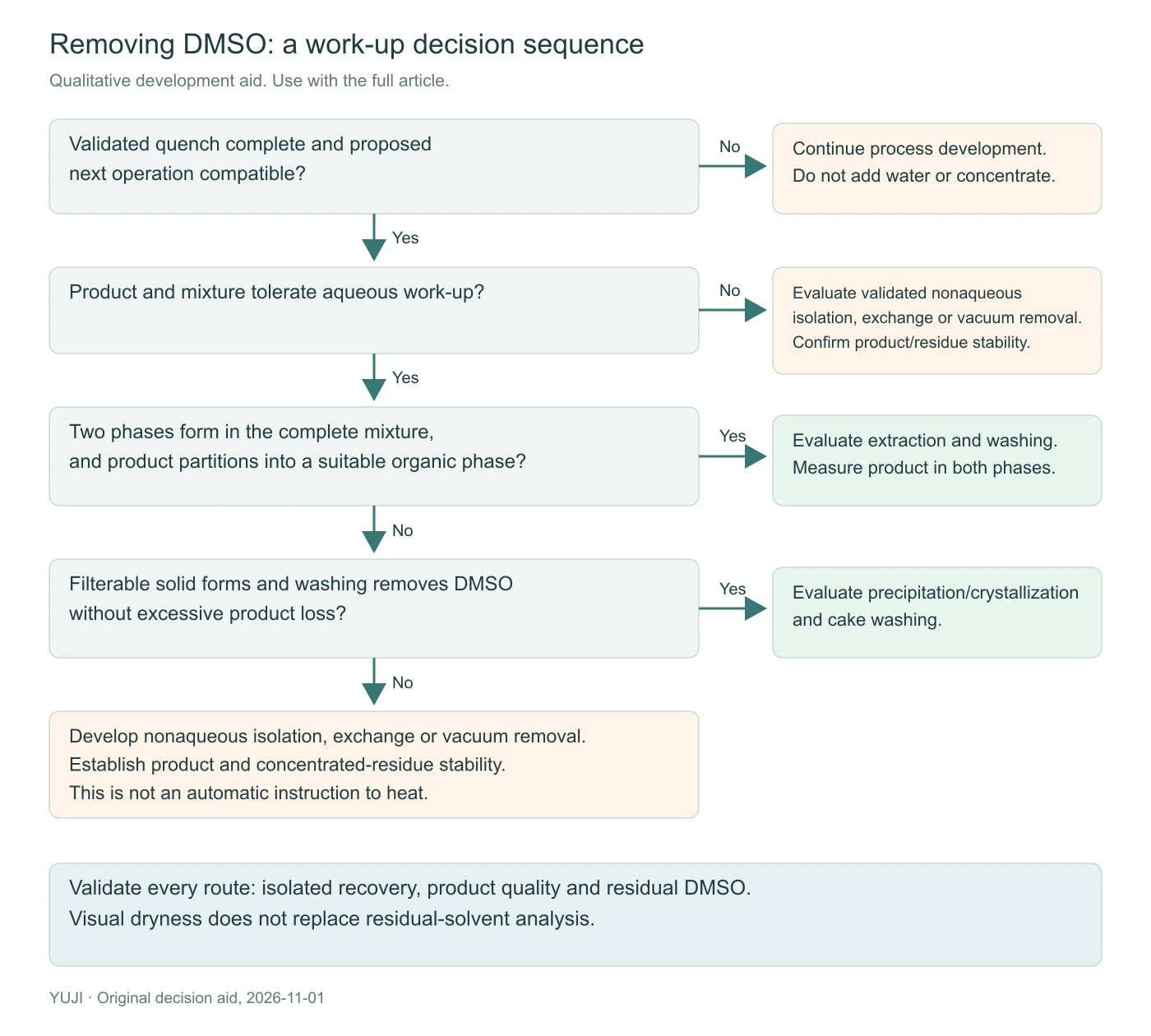
1. Before adding water, changing pH or concentrating, establish that residual reactive material has been dealt with in a validated quench and that the proposed next operation is compatible with the mixture. If that is not established, stop at process development.
2. If the product tolerates an aqueous work-up, test whether the complete mixture forms two liquid phases and whether the product partitions into a suitable water-immiscible organic phase. If both conditions are met, evaluate extraction and washing.
3. If extraction is unsuitable, test whether the product can form a filterable solid from a compatible mixture and whether washing removes DMSO without excessive product loss. If so, evaluate precipitation or crystallization and cake washing.
4. If aqueous routes do not fit, or neither separation works, evaluate a validated nonaqueous isolation, solvent exchange or reduced-pressure removal. Product and residue stability must support the concentration conditions. An unresolved branch calls for further development, not an automatic instruction to heat.
5. For every route, measure isolated recovery, product quality and residual DMSO. A visually dry product is not the endpoint.
Extraction needs the actual phase balance
DMSO changes the solvent composition. A solvent that separates from water on its own may not give the same phases in the reaction liquor. Measure product in both phases, and compare staged extraction and washing against solvent use, aqueous waste and product loss.
For ionizable products, pH can change partitioning, but any adjustment must preserve product stability. Drying salts remove water from an organic extract; they do not reliably replace separation of dissolved DMSO.
A solid still needs effective washing
Water addition can produce fine particles or an oil rather than a filterable cake. Evaluate addition rate, temperature and agitation. Check product in the mother liquor, DMSO in the wet cake and the effect of wash composition and volume.
Longer drying may not correct ineffective washing, entrained mother liquor or solvent retained in the crystal structure. Confirm residual DMSO after drying using a method suited to the acceptance limit.
Concentration is a separate development task
Reduced pressure can lower the required liquid temperature, but removal rate also depends on composition, viscosity and equipment. Adding a volatile solvent does not by itself establish effective solvent exchange. Demonstrate that the proposed sequence lowers DMSO while preserving the product.
Assess the reaction residue, heat input, vacuum failure and concentration endpoint before scale-up. A pure-solvent boiling point is not a safe operating temperature for a reactive residue. Select the final route using product and solvent balances, rather than boiling point alone.
For a DMSO supply enquiry, tell YUJI the incoming-solvent requirement and downstream isolation route so that the specification reflects the complete process.