
DMSO’s low volatility, water miscibility and solidification near room temperature affect how it is stored, transferred and removed. Reference properties help explain these behaviors. They are not batch COA results, sales limits or approved operating conditions.
In this article
Reference values and their conditions
Normal boiling point: approximately 189°C at about 101.3 kPa. This describes the pure substance near atmospheric pressure, not the boiling temperature of every process mixture.
Melting point: approximately 18.5°C for pure DMSO. Water and other components change phase behavior; this value is not a purity test or a freezing specification for a formulation.
Water solubility: miscible. A DMSO-containing reaction mixture may still form several phases because other solvents, salts and products are present.
Relative density: approximately 1.1, water = 1, as reported in ICSC 0459. The card does not attach a temperature to this rounded entry; do not use it for precision fill-volume conversion.
Kinematic viscosity: 1.95 mm²/s at 20°C, reported in ICSC 0459. Kinematic viscosity and dynamic viscosity have different units. Converting to mPa·s requires density at the same temperature.
Vapor pressure: 59.4 Pa at 20°C, reported in ICSC 0459. This is about 0.0594 kPa; it is not zero vapor pressure.
Temperature changes the vapor-pressure picture
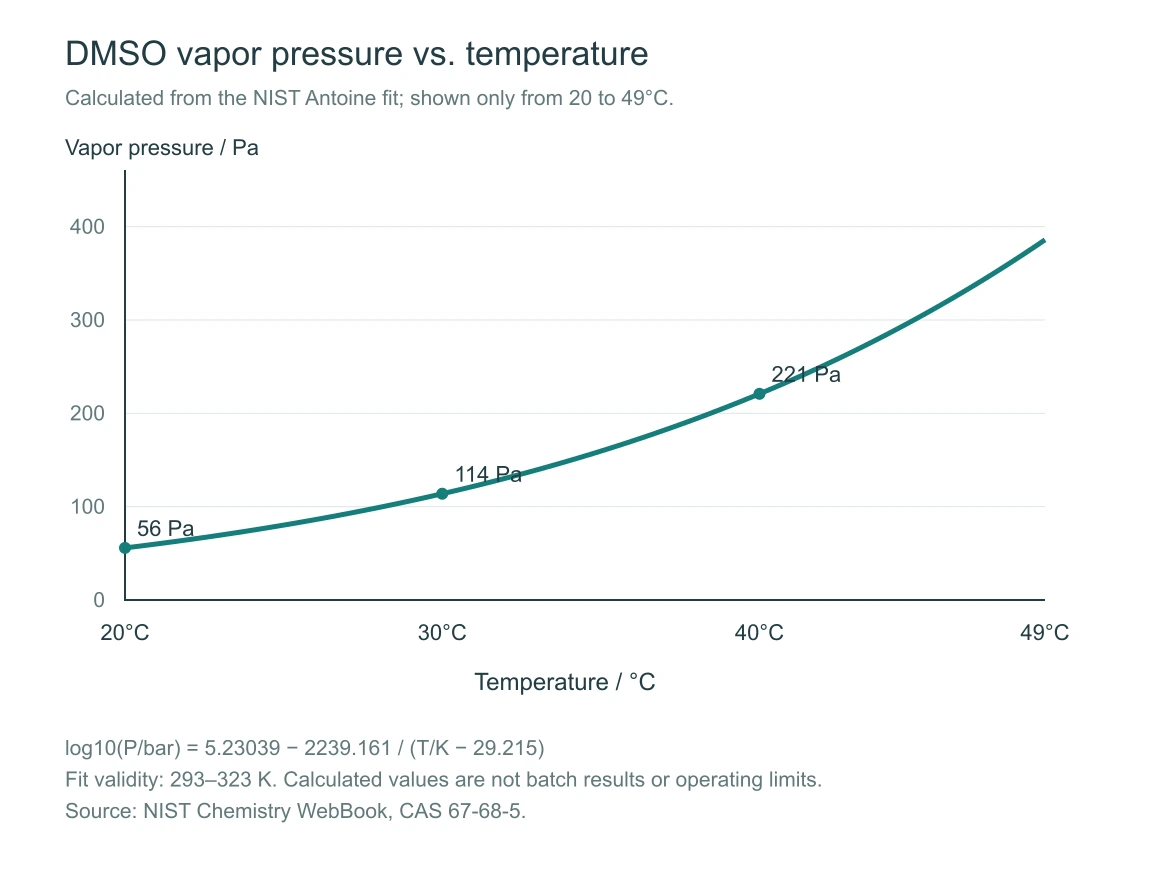
NIST provides an Antoine vapor-pressure correlation with pressure in bar and temperature in kelvin. One listed fit is valid from 293 to 323 K, using A = 5.23039, B = 2239.161 and C = −29.215 in log10(P) = A − B/(T + C).
Calculated and rounded values from this fit are approximately 56 Pa at 20°C, 114 Pa at 30°C and 221 Pa at 40°C. The fitted 20°C result differs from the ICSC reference value above; these are separate reference sources, not interchangeable exact data. They are not measurements of a supplied batch. The accompanying curve uses this fit only within its stated range.
Higher temperature increases the vapor pressure. Low room-temperature volatility therefore does not remove the need to assess heated transfer, aerosols or vent streams. Do not extend the fit to a distillation temperature outside its validity range.
Use mixture data where the process needs them
Pure-DMSO values cannot define a DMSO/water recovery operation. Vapor–liquid equilibrium describes how the liquid and vapor compositions differ at a specified pressure. Published DMSO/water equilibrium studies are a starting point for separation design, alongside the actual feed and equipment.
Likewise, pump selection and fill calculations need composition- and temperature-appropriate density and viscosity. A polymer dope, recovered solvent or formulated cleaner should not inherit the pure-solvent value without evaluation.
For thermal operation, evaluate the complete mixture and residues. Boiling point and melting point do not establish chemical compatibility or a safe heating limit. Keep reference data separate from incoming-solvent specifications and process acceptance criteria.
Use these reference properties to frame the process discussion. For purchasing, ask YUJI for the current supply specification and batch documentation relevant to your application.