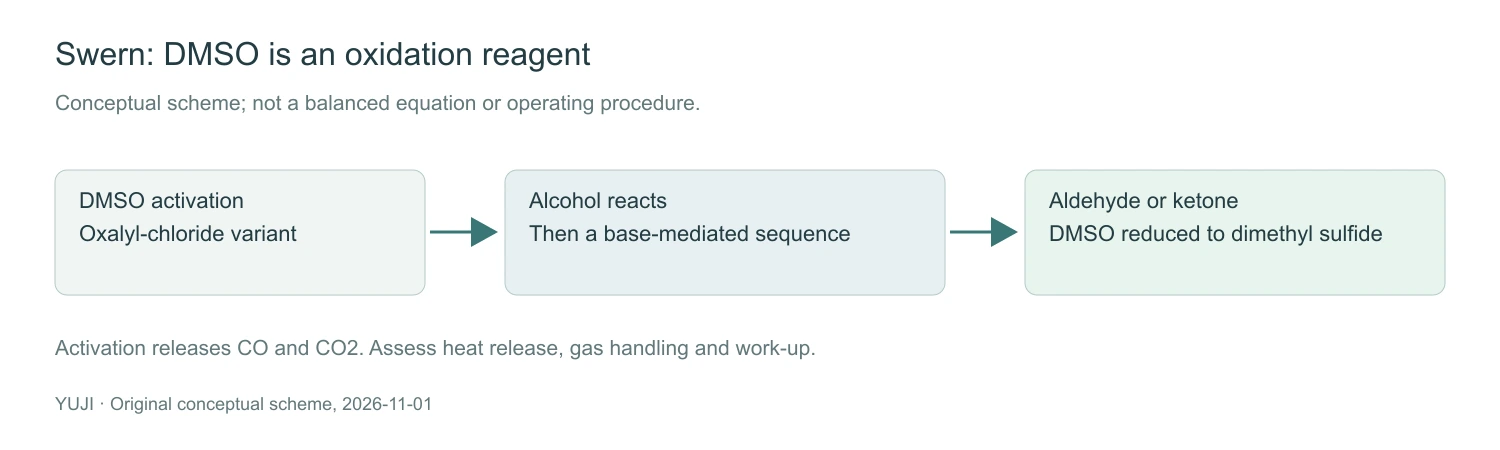
In Swern oxidation, DMSO is a reagent used to convert primary alcohols to aldehydes and secondary alcohols to ketones. In the common oxalyl-chloride variant, DMSO is activated before it reacts with the alcohol. It is consumed in the chemistry rather than serving only as an inert solvent.
Follow the activation and alcohol steps separately
Oxalyl chloride activates DMSO to form a chlorosulfonium species. Reaction with the alcohol gives an alkoxysulfonium intermediate; the subsequent base-mediated sequence produces the carbonyl compound and dimethyl sulfide. Carbon monoxide and carbon dioxide are generated during activation.
The net transformation is R–CH2OH → R–CHO, or R2CHOH → R2C=O. The substrate’s original alcohol oxygen becomes the carbonyl oxygen. DMSO enables the oxidation through the activated sulfur chemistry; it should not be described as simply donating an oxygen atom to an alkene.
Many procedures use another solvent for the reaction medium. A requirement for DMSO in a Swern step therefore does not necessarily mean that DMSO is the largest liquid charge.
Water and dosing affect the activation balance
Water can consume moisture-sensitive activation reagent and change the effective reagent balance. Set a DMSO water requirement alongside the dryness of the other feeds and equipment. A purity percentage alone does not define this balance.
During development, relate the addition sequence and rate to the measured heat release, gas evolution and reaction profile. Temperature control affects both activation and possible side reactions. Conditions demonstrated for one substrate and equipment arrangement should not become a universal Swern temperature specification.
Plan gas handling and isolation with the oxidation
This chemistry requires assessment of cooling capacity, gas release and the consequences of interrupted agitation or dosing. Carbon monoxide exposure and pressure buildup must be addressed in the process design. Dimethyl sulfide is volatile and odorous, so its handling belongs in the vent and work-up assessment.
Check unreacted alcohol, the desired aldehyde or ketone and relevant side products before isolation. Then establish product stability during quench, washing and concentration. Residual DMSO, dimethyl sulfide and amine-derived material should be considered according to the actual product and downstream step.
For this reagent use, share the DMSO assay, water requirement and package size established for your oxidation with YUJI.