
Corey–Chaykovsky epoxidation forms an epoxide from a suitable aldehyde or ketone using a sulfur ylide. DMSO can be the reaction medium in selected systems. It can also be a starting material for sulfoxonium salts used as ylide precursors, but these are separate roles.
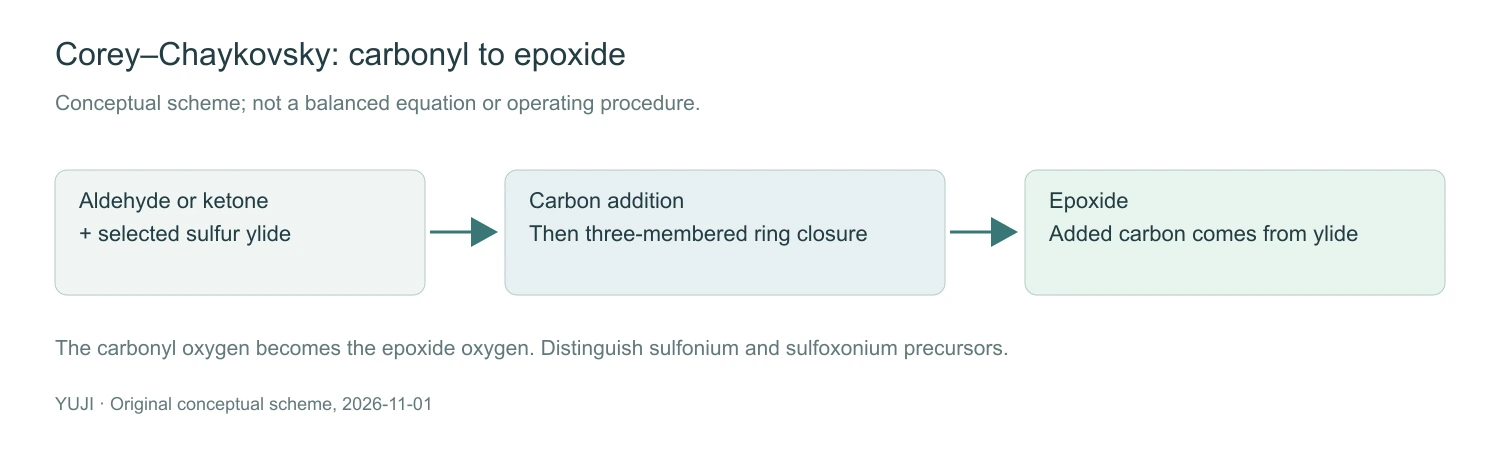
The added carbon comes from the ylide
The ylide carbon attacks the carbonyl carbon. The resulting intermediate then closes to a three-membered ring as the sulfur-containing group leaves. The carbonyl oxygen becomes the epoxide oxygen, while the ylide supplies the added carbon.
A simplified reaction map is aldehyde or ketone + methylene-transfer sulfur ylide → epoxide. This differs from oxygen transfer to an existing carbon–carbon double bond. Using the word epoxidation without identifying the starting functional group can obscure that difference.
Sulfonium and sulfoxonium ylides have different structures and reactivities. Their salts, counterions and base requirements should be identified explicitly; a change of precursor is not merely a change of product name.
A steroid-intermediate example
CN113528607A describes a spironolactone route in which a protected steroid 17-ketone is converted to an epoxide in DMSO using trimethylsulfonium bromide and sodium ethoxide. This places DMSO at a specific carbonyl-to-epoxide step before later transformations build the final product.
For a constrained steroid substrate, follow the desired epoxide and any stereoisomeric or other by-products. A reaction assay should establish which product has formed, not only that the ketone has disappeared. The later use of the epoxide determines which impurities need particular attention.
Evaluate the base system before scale-up
Water can change the effective base and ylide balance. Define the solvent requirement together with precursor quality, feed composition and sampling practice. Increasing base to compensate for uncertain water introduces another variable rather than resolving the original uncertainty.
Sodium hydride/DMSO mixtures have documented explosion hazards. Published use is not evidence of safe transfer to another scale; the complete base/solvent system requires process-safety evaluation.
After the reaction, assess epoxide stability during quench and isolation. Washing, residual sulfur-containing material and solvent removal need to preserve the intermediate required for the next step.
For a selected ylide route, YUJI can discuss DMSO sourcing against your established solvent specification and handling requirements.